


Trading has a way of making you feel like you should always be doing something.
You open the charts and feel like you should find another trade. A position that’s working pulls back for two days and suddenly you’re wondering whether to sell it. Another stock breaks out and the one you already own starts looking boring.
There’s always another decision available.
That doesn’t mean you need to make it.
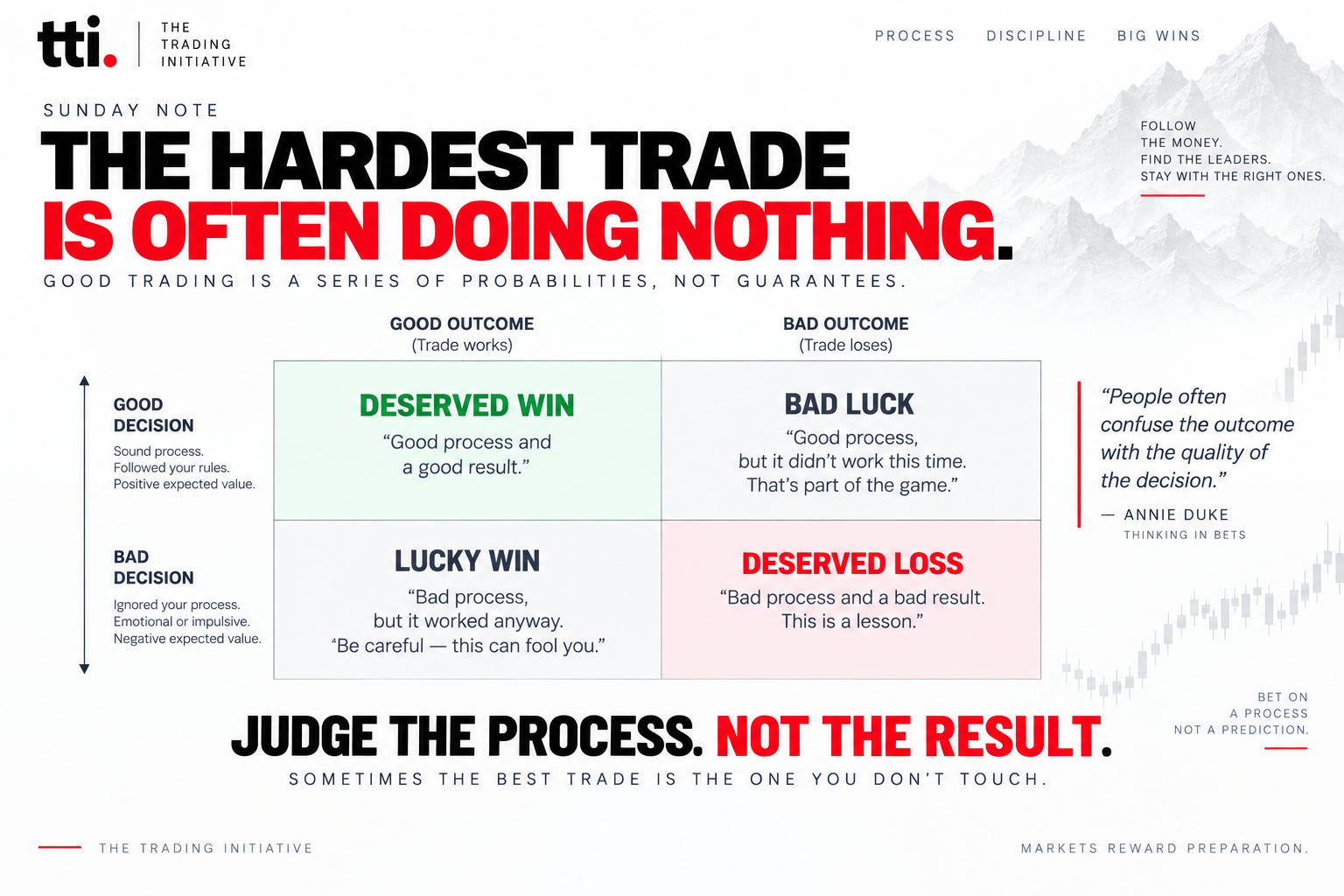
One of the ideas that stuck with me from Annie Duke’s Thinking in Bets is how easily we confuse the quality of a decision with the quality of the outcome.
She calls it “resulting.”
A bad decision can make money. A good decision can lose money.
Buy a random ticker with no plan and it gaps up 15% the next morning? Great outcome. Still a terrible process.
Find a leading stock in a leading industry, wait for a defined setup, manage the risk properly and then get stopped out by an unexpected headline? Bad outcome. That doesn’t necessarily mean the decision was wrong.
Trading gets dangerous when we let the last result rewrite the process.
That’s also why I want most of the important thinking done before I enter a trade.
Why am I buying it? Where am I wrong? How much am I willing to risk? What would make me stay if the trade starts working?
Once those questions are answered, sometimes the highest-quality decision available is simply:
Do nothing.
If the stock is still leading, the trend is intact and the reason you bought hasn’t changed, clicking more buttons doesn’t automatically improve the trade.
Activity is not the same thing as progress.
Patience isn’t stubbornness either. If the evidence changes, we act.
But if we owned a great stock on Friday for good reasons and those reasons are still true on Monday, sometimes the best decision Monday is exactly the same one:
Keep owning it.
The hardest trade is often doing nothing.
And sometimes that’s exactly what allows a good trade to become a great one.
This Week at TTI
We spent a lot of time this week talking about leadership.
Institutions Are Buying Bitcoin Again
Bitcoin continued showing exceptional relative strength while institutional ETF demand accelerated, giving us another example of price and capital flows reinforcing one another.
History Favors What’s Next
We looked at the presidential cycle and entered a stretch that has historically been much more favorable for equities, while emphasizing that seasonality is context—not a reason to blindly buy everything.
Breadth Is So Bad It Might Be Good
Breadth remained compressed beneath the indexes, yet technology continued pushing into new highs. That leaves us watching closely for a potential expansion in participation if the leaders hold and the rest of the market begins catching up.
George Soros Changed How I Trade
Yesterday we went deeper into reflexivity.. why price, perception and reality can reinforce one another, and why great trends can travel much further than people expect.
Different subjects. Same basic idea:
Find what the market is rewarding. Define your risk. Then don’t interfere without a good reason.
What I’m Watching Next Week
Three things are at the top of my list.
Breadth.
The indexes are holding near highs while participation underneath the surface remains weak. I want to see whether more stocks begin reclaiming their short-term trends.
Technology leadership.
XLK and equal-weight technology are already breaking out. I want those leaders to keep acting like leaders.
Bond flows.
This is probably the most interesting new piece of work for me. Money moving into bond ETFs has become unusually aggressive, and with the bond market already front and center for investors, I want to understand exactly where that capital is going.
That’s likely where we’ll start this week.
Have a great Sunday.
We’ll be back at it tomorrow.
Follow the money,
Hamilton
Founder, The Trading Initiative