


A trade makes more sense when you can see the work behind it.
Most people first find TTI through something I’ve written about the market.
Inside the membership, you can follow that thinking into an actual trade: what caught my attention, the price I was willing to pay, where I would exit if I was wrong, and how I managed the position afterward.
I’ve spent 17 years developing this process. One trade will give you a better sense of how we use it together.
On October 27, 2025, Bri posted this in our Discord:
Thanks for the trade, Hammy!!
AMD pop on news…my first $400k trade!!

Bri’s October 27, 2025 screenshot displays +$425,132.66 (+1,781.23%) total gain/loss on AMD January 16, 2026 $230 calls.
That was an extraordinary moment for a member of our community. The work behind it began months earlier.
TTI Membership gives you access to that work: the market research, the trade plan, the risk, and the decisions we make after entry.
Let me show you what I mean.
On August 5, 2025, we published a plan for AMD’s January 16, 2026 $230 calls around $7.80.
AMD was trending above a rising 200-day moving average, showing bullish momentum and relative strength within semiconductors. Earnings were that evening, so the writeup addressed the event risk and position sizing. It also defined a close below $150 as the point to exit if the breakout failed.
The profit-taking plan was there from the beginning: sell half if the options doubled.
On October 6, AMD gapped sharply higher. Our calls were trading near a 200% gain, and we sent the instruction to sell half.
Three weeks later, Bri posted the screenshot at the top of this page.
There is another part of this trade worth seeing.
AMD never reached our $300 target. In January, our closing update called for selling the remaining contracts around $7.30—roughly 6% below the original entry.
The earlier profit-taking made the difference. We had sold half into October’s strength, so the final portion could finish below our purchase price while the overall trade remained profitable.
Selling some meant accepting that we would own fewer contracts if AMD kept running. In exchange, we banked part of the move while it was available.
You learn something useful when you can follow that decision all the way through.
The same contract can produce very different results.
AppLovin gives us another useful example.
On May 16, 2024, our published plan included the January 17, 2025 $130 calls, with a maximum purchase price of $4.00. It defined a close below $73 in the stock as the point to exit, and called for selling half if the options gained 100%.
In November, Charly shared this:
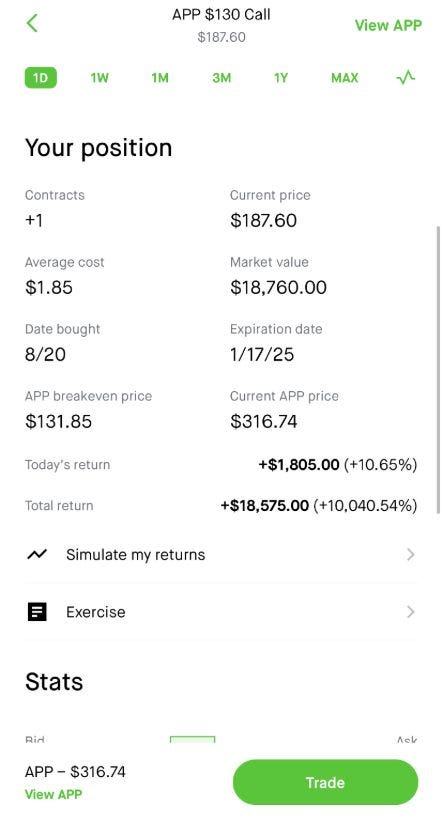
November 19, 2024: one APP January 17, 2025 $130 call, with a displayed open gain of $18,575 (+10,040.54%). The screenshot shows an August 20 purchase and $1.85 average cost.
It was the same contract we had written about in May. But Charly entered later and paid $1.85, well below our original $4.00 ceiling. His return belongs to his entry and his position.
On December 11, he reported selling his final APP contracts for roughly 11,500%. In the same post, he also described a difficult month after increasing his position size and entering too many bad positions.
That belongs in the story too. A spectacular winner does not settle every question about how much to risk on the next trade.
Those are the conversations we have inside TTI: how to recognize an opportunity, what price makes sense, when to take some profits, and how to keep your position size from becoming the problem.
Come see how the decisions get made.
I have been developing this approach over 17 years of trading. I walk through it in My Trading System: 17 Years and Counting.
This publication gives you a look at the process. Inside TTI Membership, we put it to work together.
We start with the market: whether conditions support taking more risk, being selective, or waiting. Then we examine where capital is moving, which stocks are leading, and whether a setup offers an entry we can actually use.
From there, we build the plan and manage the position as the evidence changes.
Your membership includes:
The TTI Trade Desk: market context, capital-flow research, the Scanner and Radar, developing trade plans, and a timestamped Trade Feed for shared entries, adjustments, profit-taking, and exits.
The Desk Note: my market read after every regular U.S. market trading day, so you can see what changed and what deserves attention.
Private Discord access and live trading every weekday: a place to discuss the market, ask questions, and see how other members approach their trades.
Three coaching sessions in a standard trading week, with replays within 24 hours: time to work through the reasoning in more depth.
Practical education and the member hub: lessons and research you can return to as you develop your own process.
When you join, you can work through the research that led to a trade, bring your questions to the sessions, and follow the decisions afterward.
Over time, the aim is to develop your own judgment: recognize a setup, understand the risk, and know what you intend to do before the next move forces a decision.
That is what I want this community to help you build.
The Trading Initiative provides educational market research and decision-support tools. We do not manage your account or provide personalized investment advice. Trading involves substantial risk; options can lose the full premium committed. Past performance does not guarantee future results. You remain responsible for your decisions, position size, orders, and execution.
