


In a different life, I thought I was going to be an economist.
I was gullible enough to sit through a bachelor’s of science in economics.
And stupid enough to sit through two more years in graduate school.
But hey — I have a cool set of degrees. And I can hold my own on X among the other armchair economists.
To be clear.. I got my first role in the business right at the tail end of the GFC through Merrill.. and the most use I got out of them was passing the economics section on the Series 7.
And to be fair.. my hiring manager at the time told me he was bringing me on for my EQ, not my IQ.
Which at the time felt really rude. But looking back.. he was probably right.

From the moment I was hired onto Merrill until today, I’ve only known one archetype of Fed chairman: the demand side guy.
Ben Bernanke was a demand side guy.
Janet Yellen was a demand side guy.
Jerome Powell was a demand side guy.
For 20 years, the Fed was dominated by a demand side framework.
When the economy ran too hot, the Fed raised rates to reduce spending.
And when it became too cold, the Fed lowered rates to encourage spending.
It was focused around the consumer. That’s the big point here.
For nearly 20 years, traders learned to view everything through that lens.
Strong growth meant inflation, weak growth meant rate cuts.. and bad economic news could become good news for stocks because it brought the Fed closer to providing cheaper money.
To be fair.. I am oversimplifying here.. because every Fed chair considers both supply and demand.
But interest rates primarily work by changing demand so demand became the side of the economy that mattered most.
Kevin Warsh is the polar opposite. And that’s pissing people off both in the market and on X.
Think about it like this..
You see a busy restaurant.
A demand side economist sees 50 tables and 75 customers.
There aren’t enough seats for everyone.. so prices begin rising.
The solution is to reduce the number of customers.
Raise rates.
Make borrowing more expensive.
Convince some people to stay home.
And eventually demand falls back in line with the restaurant’s capacity.
In economics, we call that price equilibrium. HELL YEAH.
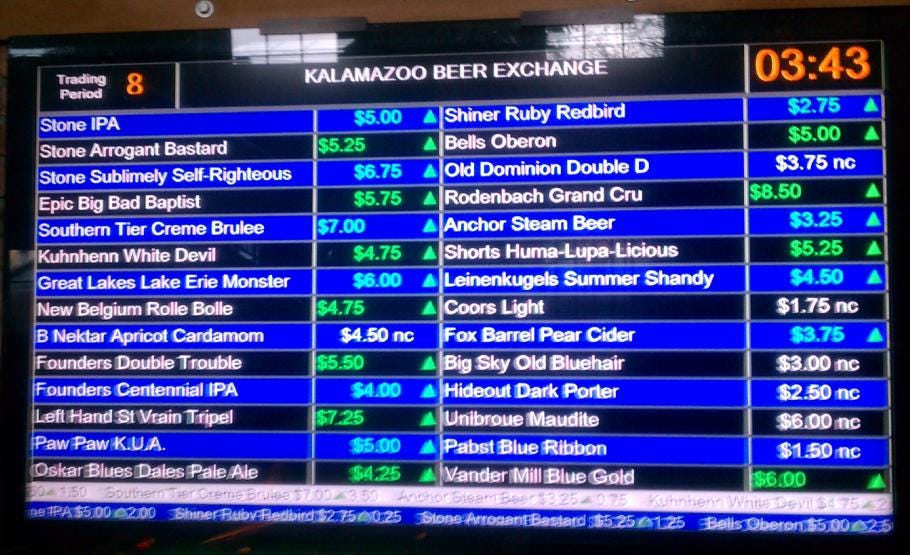
By the way.. this actually exists.
Now.. a supply side economist asks a very different question.
What if the restaurant buys a larger oven? Adds more tables?
What if technology aka AI helps the kitchen prepare every meal faster?
Now the restaurant can serve more customers without raising prices.
The demand for the restaurant didn’t disappear.. the restaurant just became way more productive.
That difference might sound small.
It isn’t.
It changes how the Fed and Warsh interprets economic growth.
The problem begins when every inflation problem is treated like a demand problem.
Higher interest rates can discourage someone from buying a house.
But it won’t build more houses.
Higher rates can reduce the amount of gas you purchase.
But it won’t produce more oil.
Higher rates can slow corporate investment.
But it can’t unload a container ship, build a new semiconductor manufacturing facility, or train another electrician.
You can’t fix a slow kitchen by asking fewer people to eat. PEOPLE GOTTA EAT.
And when the Fed attacks a supply problem by jacking up rates to reduce consumer demand, corporate profitability gets hit.
Companies sell less because consumers slow their buying.
At the same time, businesses pay more to borrow, refinance debt, and invest in future growth.
That may be necessary when demand truly is excessive.
But it can be and oftentimes is destructive when the economy’s productive capacity is expanding. Like it is right now.
Warsh’s supply side framework starts from a more optimistic possibility.
AI, automation, capital investment, deregulation (hell yeah Bessent), and technological progress may allow the economy to produce more with the same amount of labor and capital.
If each worker can produce more every hour, wages can rise without forcing companies to raise prices by the same amount.
Under this assumption, growth doesn’t automatically create inflation.
Growth becomes inflationary when demand grows faster than the economy’s ability to produce.
Here’s What’s Interesting to Me
The latest productivity data gives us an early look at what Warsh is looking at.
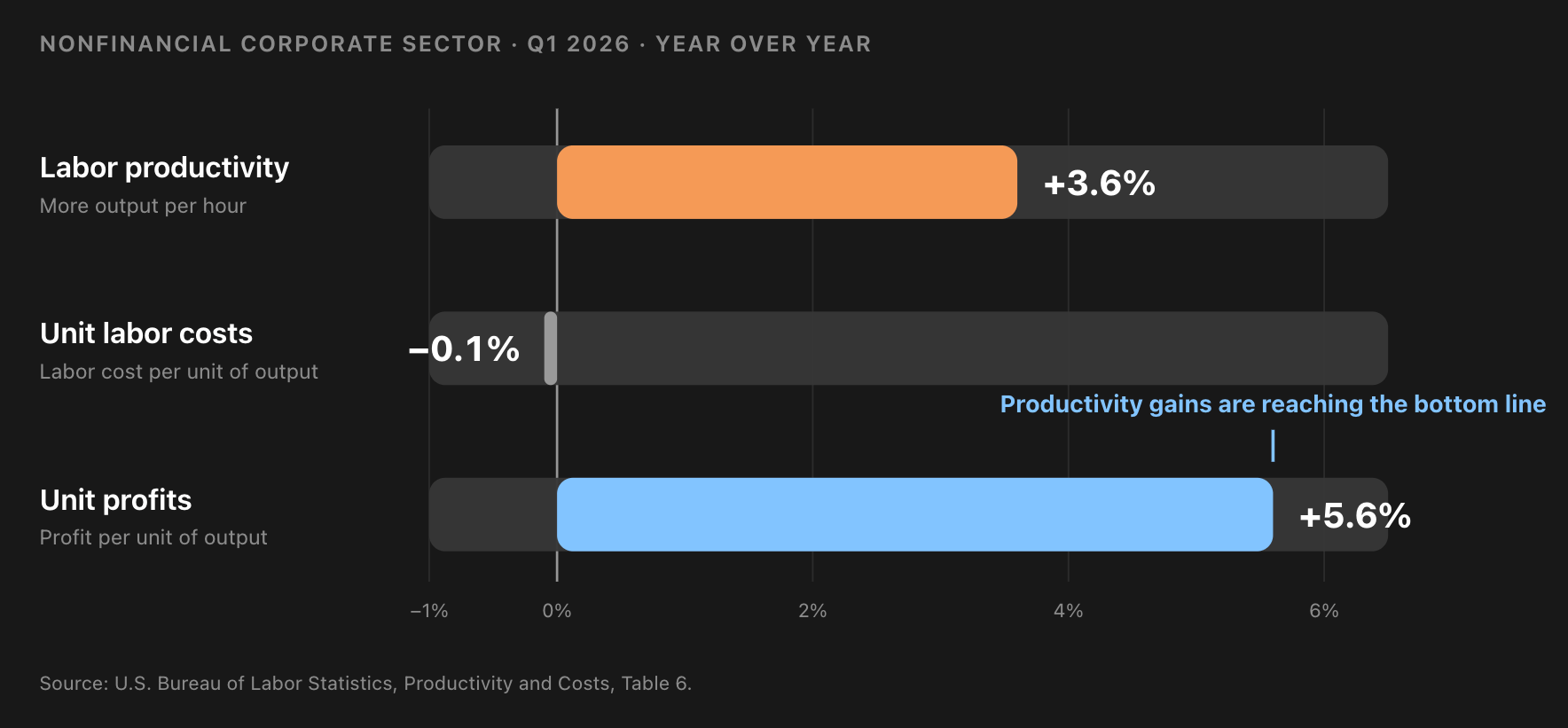
Over the past year, output from nonfinancial corporations increased 4.1%.
Hours worked increased only 0.5%.
That means companies produced considerably more without requiring a similar increase in labor.
Productivity rose 3.6%.
Unit labor costs (the amount companies spend on labor to produce one unit of output) actually declined slightly.
And unit profits rose 5.6%.
That’s what Warsh and family want to see. That’s the supply side equation.
Produce more from every hour worked while keeping the cost of producing each unit under control.
Allow wages, output, and profits to grow without requiring the same increase in prices.
Warsh knows that the Fed can’t manufacture productivity.
It can’t build the data centers that the hyperscalers are building, generate electricity, or teach companies how to use AI.
But it can avoid making a serious mistake..
Treating productive growth like inflationary growth.
If the economy’s capacity is expanding faster than the Fed’s models recognize, raising rates to suppress that growth could discourage the exact investment creating more supply.
That also means traders may need to reconsider an old habit.
For years, the bullish outcome that everyone wanted to see was weak economic data followed by lower interest rates.
Under a supply side framework.. strong growth can be bullish on its own because companies are producing more efficiently and earning more money.
It may not bring rate cuts.. faster productivity can support a stronger economy and a higher neutral interest rate.
But that’s not necessarily bad news.
We’ve become ADDICTED to QE and LOW RATES.
The optimistic case isn’t to make money cheaper. It’s an economy that no longer needs cheap money to grow.
The good news is that spending is already betting on that possibility.
Companies are spending enormous amounts of capex on data centers, automation, semiconductors, power generation, and the infrastructure required to make AI useful.
The next step is separating the companies simply spending money from those turning that spending into productivity and profits.
That’s where the real opportunity is. And we may be seeing it over the next couple of quarters.
Parting thoughts..
Reading X tonight is like walking into a Kindergarten class and watching the biggest kid in the room start crying, followed by everyone else crying along with him.
When will the Fed come to the rescue? Look at the KOSPI! Look at the semiconductor rally that just ran hundreds of percent in two god damn months!
Here’s the reality.. Kevin Warsh is asking whether the economy needs to be rescued at all.
The demand side framework treats growth as something the Fed may eventually need to control by curtailing the consumer. YOU. YOUR SPENDING.
The supply side framework recognizes that the economy’s capacity can change. GROWTH. PRODUCE MORE STUFF.
The market spent 20 years learning to cheer for weakness because weakness brought cheaper money.
Somewhere along the way, we forgot that Americans don’t cheer for weakness.
It’s about time we’re being forced to remember how to cheer for strength.
If you want to read my thoughts every morning, sign up here for free below:
I write about capital flow, market cycles, sector rotations, hot tipz on stocks, and whatever else I think is cool.
Feel free to reply back to any of the newsletters and talk shop.