


After todays close, our Market Desk moved from Participate selectively to Reduce aggression.
There are still stocks I want to own. Plenty of charts worth looking at. But when I run through the bigger picture, there’s less and less supporting the idea of putting more money to work right now.
So.. I want to slow down a bit.
A stock can make it onto my watchlist and still not be something I’m willing to put a full position into. The setup might be there. The market behind it might not be. And that matters when it’s my money on the line.
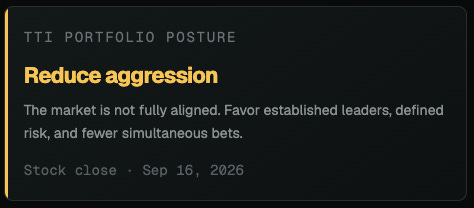
TTI Market Desk, September 16, 2026 stock-close snapshot. The posture is “Reduce aggression”: favor established leaders, defined risk, and fewer simultaneous bets.
In How I Read the Market Before I Buy a Stock, I walked through why I start with the bigger picture before looking for a trade. Well.. this is the part where that work needs to change what I actually do.
Otherwise I’m just looking at a dashboard. And I have enough things to look at already.
The Market Desk and the Market Blueprint process are included in TTI Membership, along with our research and live coaching. Let me walk you through what I’m looking at tonight and what it changes.
What the market is telling me
If I only looked at the S&P 500 and Nasdaq, I could still make a decent case for buying a pullback. Their longer term trends remain intact. Tonight the Desk has both classified as pulling back within an advance.
And maybe that’s all this ends up being. A pullback.
But I also want to know what the stocks inside those indexes are doing. How many are holding their trends? Is the strength spreading? Or are a handful of big names doing most of the work?
Across the Russell 1000 stocks covered by the Desk, only 19% are above their 20-day average, 29% above their 50-day, and 47% above their 200-day.
Look at those numbers for a second. Less than a third of the stocks are above their 50-day. Participation has weakened over the past four weeks too.. so I’m looking at a market where fewer stocks are holding up, and that number has been going in the wrong direction.
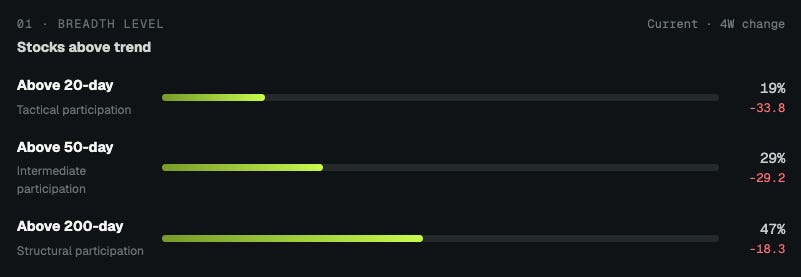
Market Desk participation snapshot, September 16, 2026. The percentages show stocks above each trend reference; the red figures show the change over four weeks.
There are also 158 stocks making new 63-day lows, against just 12 making new highs. The comparisons I use to look at risk appetite show weakness in equal-weight participation, small caps, semiconductors, and cyclical consumer stocks. Meanwhile, leadership is concentrating in the mega caps.
That’s a lot to ignore just because I found a chart I like.
There’s still strength in places. Energy and Health Care are marked as leading in tonight’s rotation view. I want to know that because it helps me narrow down where to look. Financial conditions, on the other hand, are mixed and deteriorating.
This is why I work through the whole Blueprint. Direction, participation, rotation, financial conditions, and risk appetite. Each tells me something a little different. I don’t need all of them to agree perfectly.. good luck waiting for that. But when several start weakening together, I want a much better reason to take another trade.
What “reduce aggression” changes
First thing.. I reduce what I’m willing to lose on a new position.
I still need an entry, a stop, and a reason to believe the trade is worth taking. None of that goes away. If the chart requires a certain amount of room, I adjust the size around it. Buying less of a bad setup doesn’t suddenly make it a good one.
Then I look at how much of the same bet I’m already making. If I own several stocks in the same sector, all depending on the same theme continuing higher, do I really need another one?
Sometimes another ticker is just more of what I already own. Different company. Same thing that can hurt me.
As far as stock selection goes, I want the names that are holding up. Established strength, support from the sector and industry, and somewhere sensible to get into the trade. A stock being down a lot doesn’t do much for me on its own. It can get cheaper. I want a reason to own it beyond how far it’s fallen.
I also go back through the risk that’s already in the account. Is the trade still doing what I wanted it to do? Is support holding? Am I giving it room because the plan calls for that.. or because I just don’t want to take the loss?
Those are different things.
The Desk tells me to do that review. The individual trade still has its own structure and management plan. If a position is behaving well, I can give it room to work while being a lot more cautious about opening the next one.
So no.. “reduce aggression” doesn’t mean sell everything. It doesn’t mean I’m suddenly shorting the market or calling for a crash. It means I want less money depending on everything going right at once.
How this can save me a lot of money (and pain)
Here’s a simple example of why I care about this.
Say I take three trades and risk $1,000 on each. All three lose the amount I planned for. I’m down $3,000.
Now take those same trades with $500 of risk each. Same entries. Same losers. I’m down $1,500.
Still wrong on all three trades.. but I’ve kept another $1,500 in the account.
That’s just an illustration, not a result from our system. And it assumes I get out at the planned loss. Gaps, slippage, and costs can make the actual number worse. But you can see why the amount I’m willing to lose matters before I ever get to whether I picked the right stock.
The recovery math matters too. Lose 10% of an account and it takes an 11.1% gain to get back. Lose 20% and now I need 25% just to get to even.
I’d rather have the next good stretch build on the capital I kept than spend it trying to dig myself out of a hole.
Of course the market can turn around tomorrow and make all this caution look unnecessary. Smaller positions mean less participation if it does. A trade I pass on might run without me. It happens. I’m willing to accept that when the evidence looks like this, knowing the process can be early or wrong.
But I’m NOT going to stop scanning the market, building a watchlist, and planning out my trades.
I still want to see which industries are holding up. Which stocks keep showing strength. Which charts are building something useful while the rest of the market struggles. Reducing risk and doing that work can happen at the same time.
If participation improves and price starts confirming it, I want to have already done some of the homework. I can go back to those names, check the entry and where the idea fails, and decide whether it makes sense to put more money to work.
That’s where the making money part comes back into it. I want capital available AND a list worth working from. Sitting through a rough stretch with too much exposure can make the next opportunity harder to take, even when it’s right in front of you.
This is what I want TTI to help you do
I can hand you a list of strong stocks. But it still leaves a pretty important question unanswered..
How much risk should I be taking in this market?
That’s what the Market Blueprint helps me work through before I get carried away with an individual chart. It connects the market to the sectors and industries I’m watching, then to the stock and the actual trade plan.
The same chart might deserve a smaller position today. Or it might stay on the watchlist for now. I want members to understand how I get to those decisions, including what I’d need to see before becoming more aggressive again.
Inside TTI Membership you can work through that with us using the TTI Trade Desk. You can study shared entries and management in the Trade Feed, bring questions to live coaching, work through the education, and join our private Discord with live trading every weekday.
I want you to understand why we’re taking a trade, why we’re passing on one, and why sometimes the best adjustment is simply putting less money into the next idea. Especially when you really like the stock. That’s when having a process to come back to is useful.
Tonight, mine says reduce aggression.
I’ll keep looking for the next trade. I’m just asking more of it before putting money behind it.
Join TTI Membership and work through the market with us.
If you find this kind of content valuable to your portfolio, consider subscribing for free to get all of the free articles and notes throughout the week.
Market observations and screenshots reflect the September 16, 2026 stock-close snapshot, not a live reading. Some financial-condition inputs update on a different schedule.
The Trading Initiative provides educational market research and decision-support tools for informational purposes. Nothing in TTI is personalized investment advice or account management. TTI does not determine what is suitable for you, place orders, or manage your money. Trading and investing involve substantial risk, including loss of principal. Options can expire worthless and may result in a 100% loss of the premium committed. Past performance does not guarantee future results. You remain responsible for your decisions, position size, orders, and execution.