


Credit is flashing a warning
The weakest borrowers are taking the hit
Strong stocks still deserve our attention
You can be right about a risk and still make the wrong trade.
Yesterday, I wrote about the stronger dollar, higher interest rates and why we’re still participating selectively. Today, let’s make that practical. Knock Knock.. The Dollar Is Back
Imagine two businesses asking to borrow your money.
One makes a steady profit and pays its bills on time. The other keeps borrowing just to cover what it already owes.
You probably wouldn’t lend to both on the same terms. You’d want more interest from the struggling business because there’s a greater chance you won’t get your money back.
That’s the basic idea behind a credit spread.
A corporate bond is a loan to a company. The spread measures how much extra return investors demand compared with lending to the U.S. government.
Here’s a simple example: suppose lending $100 to the government earns you $4 a year. To lend that same $100 to a company, you might want $6. The extra $2 compensates you for taking more risk.
When investors start demanding more of that extra compensation, we pay attention.
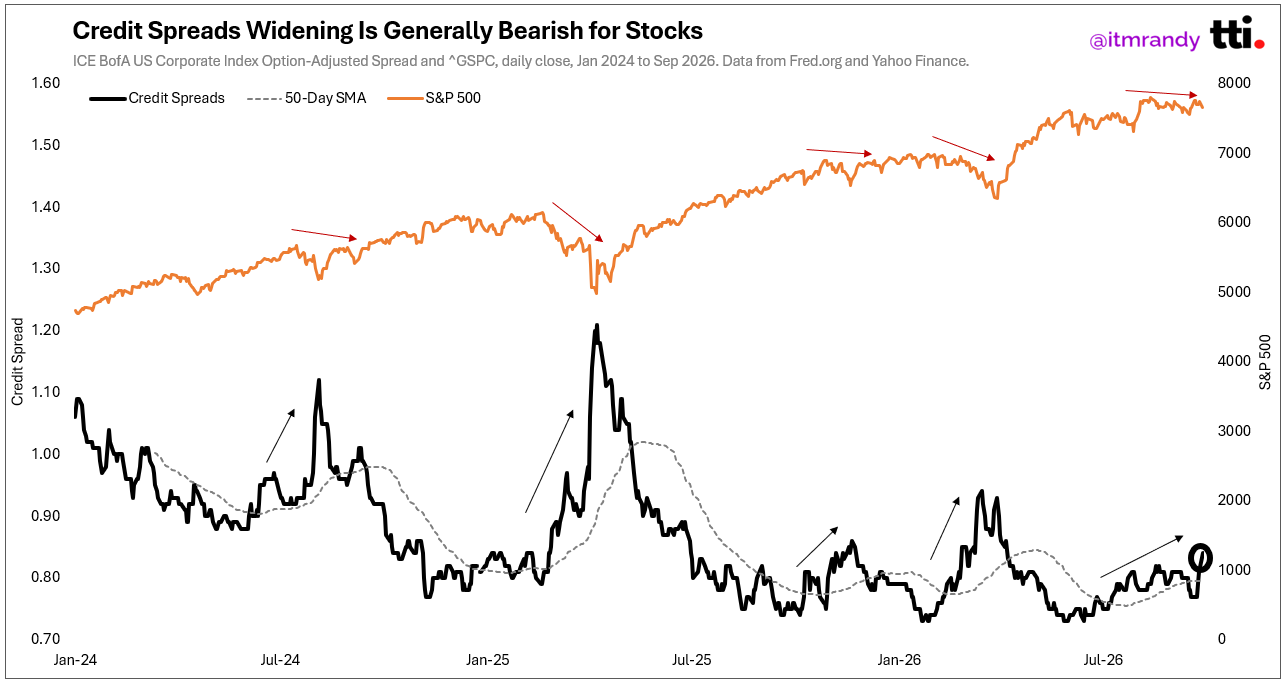
Last Thursday, Randy highlighted exactly that in The Daily Print. The credit spreads he tracks had reached their highest level in 100 days. His warning was about the possibility of rougher trading ahead.. not an instruction to sell every stock. 📊 The Daily Print - October 1,…
The next question is the important one: who are investors getting nervous about?
Market leading stocks, brutal truths and no-BS straight to your inbox by 9am.
Is the Trouble Spreading?
There will always be businesses you’d hesitate to lend money to.
What concerns me more is when weakness starts spreading from the lowest-quality borrowers into the healthier parts of the credit market.
Randy’s spread data told us that investors had become more cautious. To see where that caution is showing up, I like looking at the last six months of high-yield performance by credit quality.
On the chart, BB is the stronger group, B sits below it, and CCC and below is the weakest. You don’t need to memorize the ratings. We’re simply asking whether investors are punishing the entire high-yield market or concentrating their concern among the riskiest borrowers.
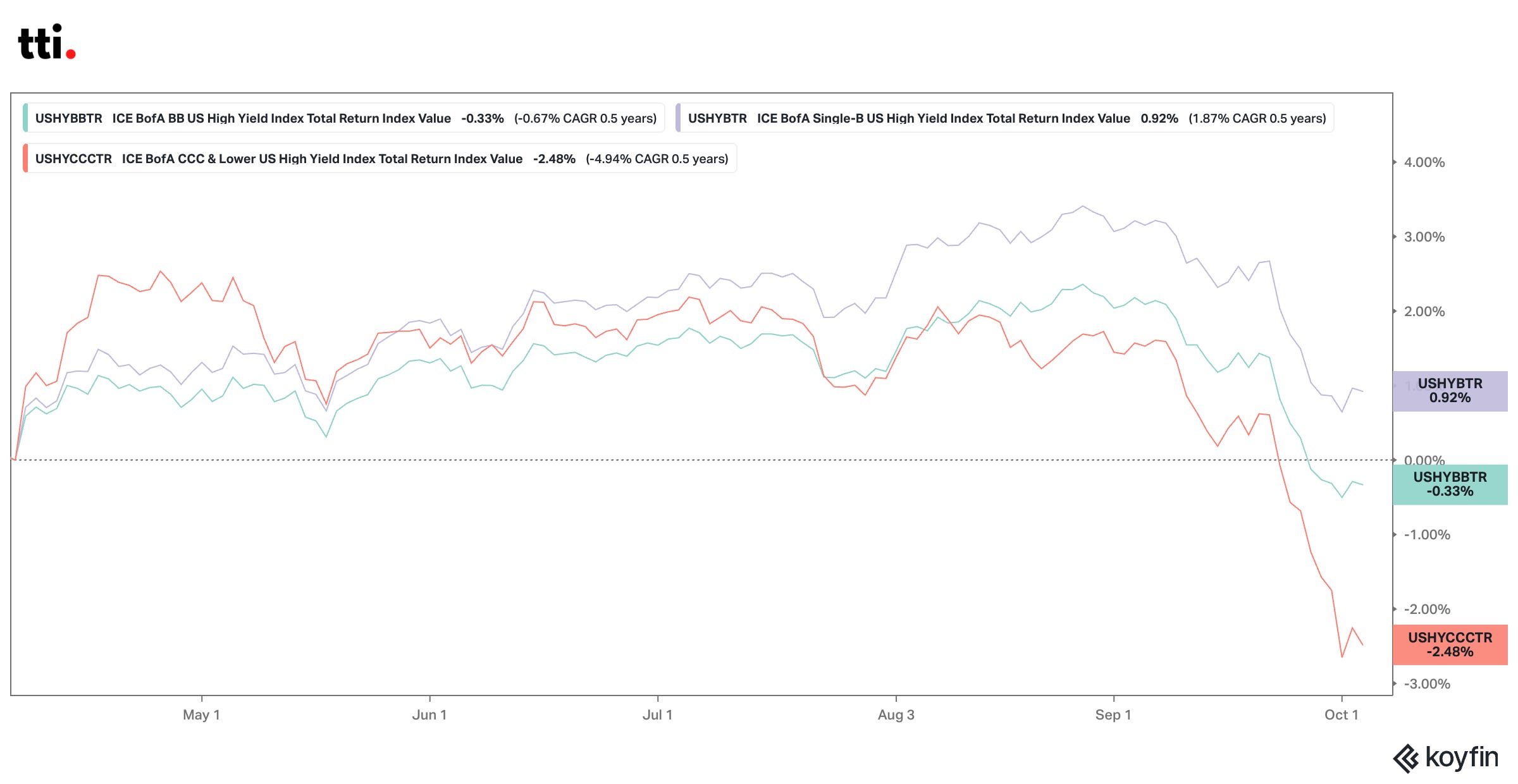
Over the past six months, the difference is pretty clear.
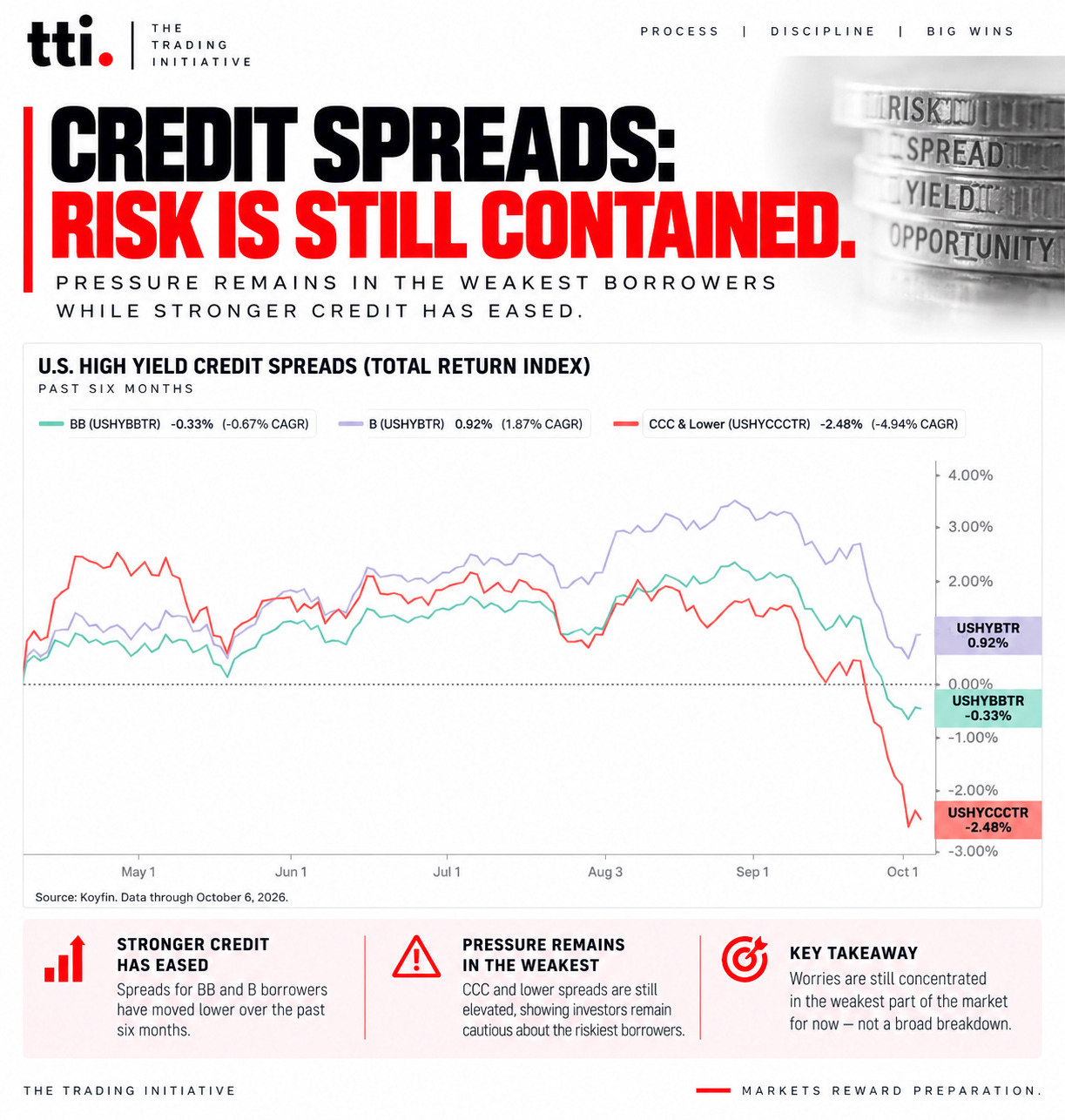
Single-B credit is up 0.92%. BB is roughly flat at -0.33%. CCC and lower is down 2.48%.
That isn’t an all-clear. But it also isn’t everything breaking together.
The weakest borrowers have materially underperformed, while the stronger portions of high yield have held up much better.
That distinction matters.
If this weakness begins spreading into BB and B credit, especially while spreads continue widening, I’ll have more evidence that investors are becoming broadly defensive.
For now, the stress looks more concentrated near the bottom of the quality spectrum.
And that changes how I respond to the warning.
I don’t want to ignore credit. But I also don’t want to sell every strong stock simply because the weakest borrowers are struggling.
Stay alert. Stay selective. And watch whether the weakness starts spreading.
Find the Strength. Know When You’re Wrong.
Randy showed us the other side of this in this morning’s Daily Print.
Technology is up about 15% since August. The S&P 500 without technology is down 1.6% over that same stretch. 📊 The Daily Print - October 8,…
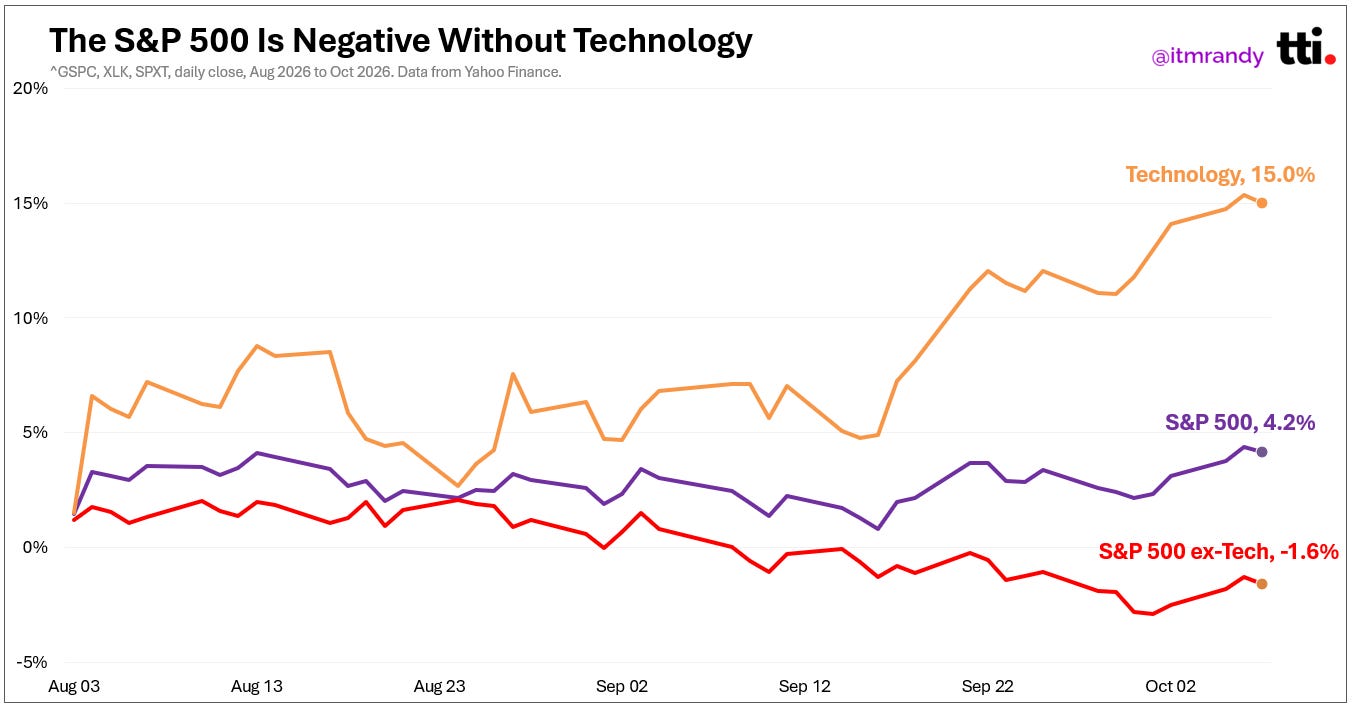
A headline about “the stock market” doesn’t tell you which side of that divide your money is on.
At TTI, I want us looking for stocks that keep climbing and holding their gains while others struggle. Then we have to find a sensible place to buy.. not chase them at any price.
Before entering, we need to know where we’re wrong: the price that would tell us the trade is no longer doing what we expected.
That’s how the research connects to an actual decision.
Credit helps us judge the conditions. The stock’s behavior helps us decide whether it deserves our money.
If investors become more nervous about lending to stronger companies, fewer stocks are going up, and our leaders begin breaking down, I’ll have more reason to pull back.
But an individual trade doesn’t get to wait for all of that.
When it reaches the price we identified as our exit, “the market still looks good” isn’t a reason to ignore the plan.
The reverse matters just as much. A stock that is doing everything we hoped doesn’t automatically deserve to be sold because something elsewhere looks worrying.
We’re trying to find the strongest stocks early in major trends and manage them into portfolio-moving wins.
We’re looking for grand slams. That requires giving the right trades room to grow without giving the wrong ones unlimited second chances.
Randy’s research helps us ask better questions. Following the money helps us find the opportunities. Managing the trade helps us protect what we earn.
That’s what I mean by participating selectively.
Follow the money,
Hamilton
Founder, The Trading Initiative
P.S. — Inside TTI, you can follow our trade alerts and management updates while learning how we approach entries, risk and exits. We bring the research, Trade Desk and live coaching together so you can understand the decisions—not just copy a ticker. Join TTI.
Educational content only. Not personalized investment advice. All trading involves risk.