


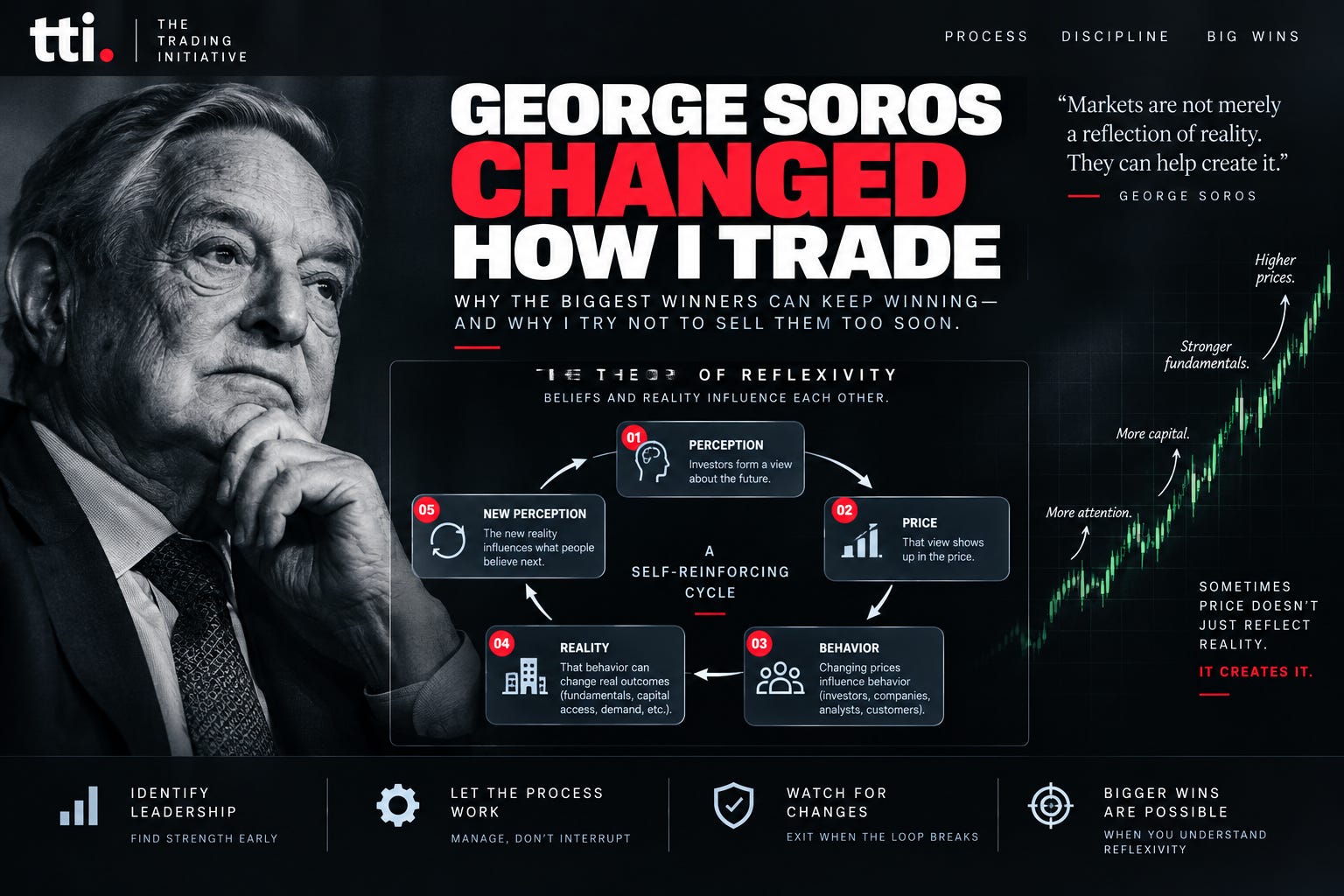
Markets can create the reality they’re pricing
Strength can become self-reinforcing
The goal is to stay with the loop while it works
George Soros changed the way I think about markets.
Not because I tried to copy his trades or suddenly decided wanted to become a macro trader. It was one idea in particular that stuck with me: reflexivity.
Once I understood it, I stopped looking at markets as a clean machine where fundamentals happen first and price simply reacts afterward. Markets are messier than that because the people participating in them are part of the system they’re trying to understand.
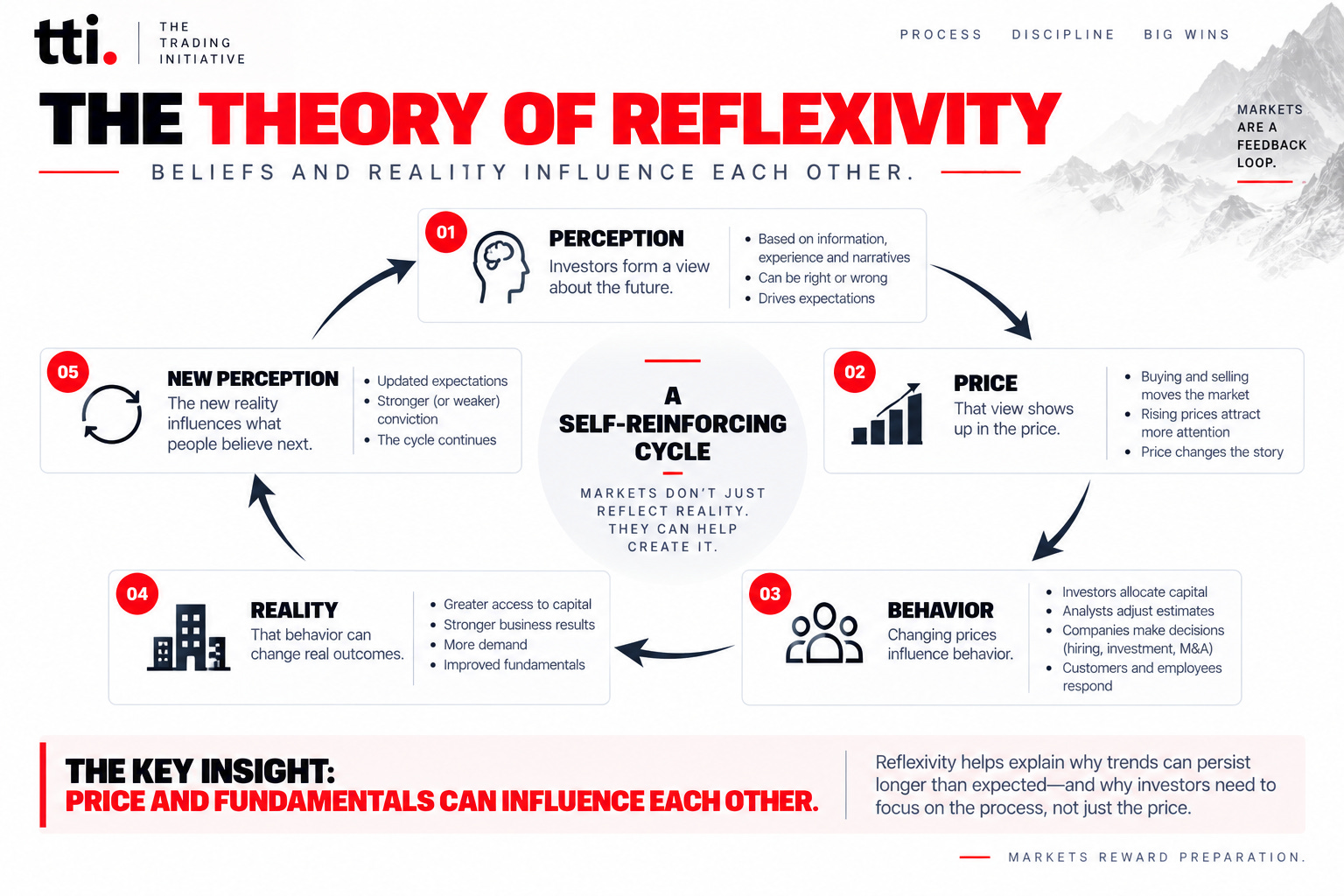
We form opinions about reality, act on those opinions, and sometimes those actions begin changing reality itself. That changed reality then influences what people believe next.
In other words, price doesn’t always sit around waiting for fundamentals to tell it what to do.
Sometimes price helps create the fundamentals everyone is trying to forecast.
That sounds philosophical, but it has had a very practical impact on how I trade.. especially when I’m sitting in a great position and wondering whether the fact that it has already gone up a lot means I should sell it.
Market leading stocks, brutal truths and no-BS straight to your inbox by 9am.
What reflexivity actually means
The traditional investing model is pretty simple.
A company improves. Revenue grows. Earnings rise. Investors recognize the improvement and the stock goes higher.
Reality changes first. Price follows.
Sometimes that’s exactly what happens.
But reflexivity adds another direction to the relationship.
Imagine a stock starts outperforming. That strength attracts attention, which attracts capital. A rising share price can make employee compensation more valuable, give management a stronger currency for acquisitions, improve access to capital and force analysts and investors who dismissed the company to reconsider their assumptions.
The stock’s strength can begin influencing the company and the people surrounding it.
If investors initially believed the future would improve, their behavior can actually help create some of that improvement.
Then the better reality reinforces the original belief.
That is the loop:
Perception changes behavior. Behavior changes reality. The changed reality changes perception again.
That is the part of Soros’s work that really stuck with me.
Markets aren’t always passive observers of the world. Sometimes they become active participants in the story they’re pricing.
Why you should care if you’re trying to make money
This matters because one of the most expensive sentences in markets is:
“It already went up too much.”
Maybe it did. But the fact that something is up 50%, 100% or 300% tells us where it has been. It tells us very little about whether the process driving it higher is finished.
I care much more about what is happening now.
Is the trend still intact? Is relative strength improving? Is momentum persistent? Is capital still flowing toward the asset? Is good news being rewarded? Are buyers continuing to show up?
Those questions tell me far more than the size of the unrealized gain.
This is where reflexivity becomes useful because sometimes the strength making investors uncomfortable is exactly what attracts the next wave of buyers.
A breakout attracts attention. Attention brings in momentum traders and institutions. Institutional sponsorship validates the move. That validation brings more capital, which pushes price higher and puts the asset in front of an even larger audience.
What looked “extended” six months ago can be another 100% higher before the loop finally breaks.
Obviously, nothing continues forever. Reflexive processes eventually weaken or reverse.
But they can persist much longer than investors expect.
Why I don’t automatically sell my best trades
Finding a truly exceptional winner is hard.
Most trades are not going to become portfolio changing trades, which is precisely why I don’t want to sabotage the few that have that potential simply because they’ve already made me money.
If trend, relative strength, momentum, capital flows and leadership continue lining up, my first instinct is not to invent an arbitrary price where I must be finished with the trade.. it’s to manage it.
That distinction has taken me years to learn.
Traders naturally like locking in profits. A 20% gain feels great. A 50% gain feels even better. You sell it, book the win and move to the next idea.
Sometimes that is absolutely the correct decision.
Other times, you just sold the best trade you were going to find all year.
A large unrealized gain is not, by itself, evidence that the trade is over.
Strength is not a sell signal.
The question is whether the conditions supporting that strength are still intact. If they are, I would rather keep managing the position than exit simply because the number on the screen has gotten large.
The very strength that makes investors uncomfortable can sometimes be the reason the trade has much further to go.
We’ve seen this firsthand
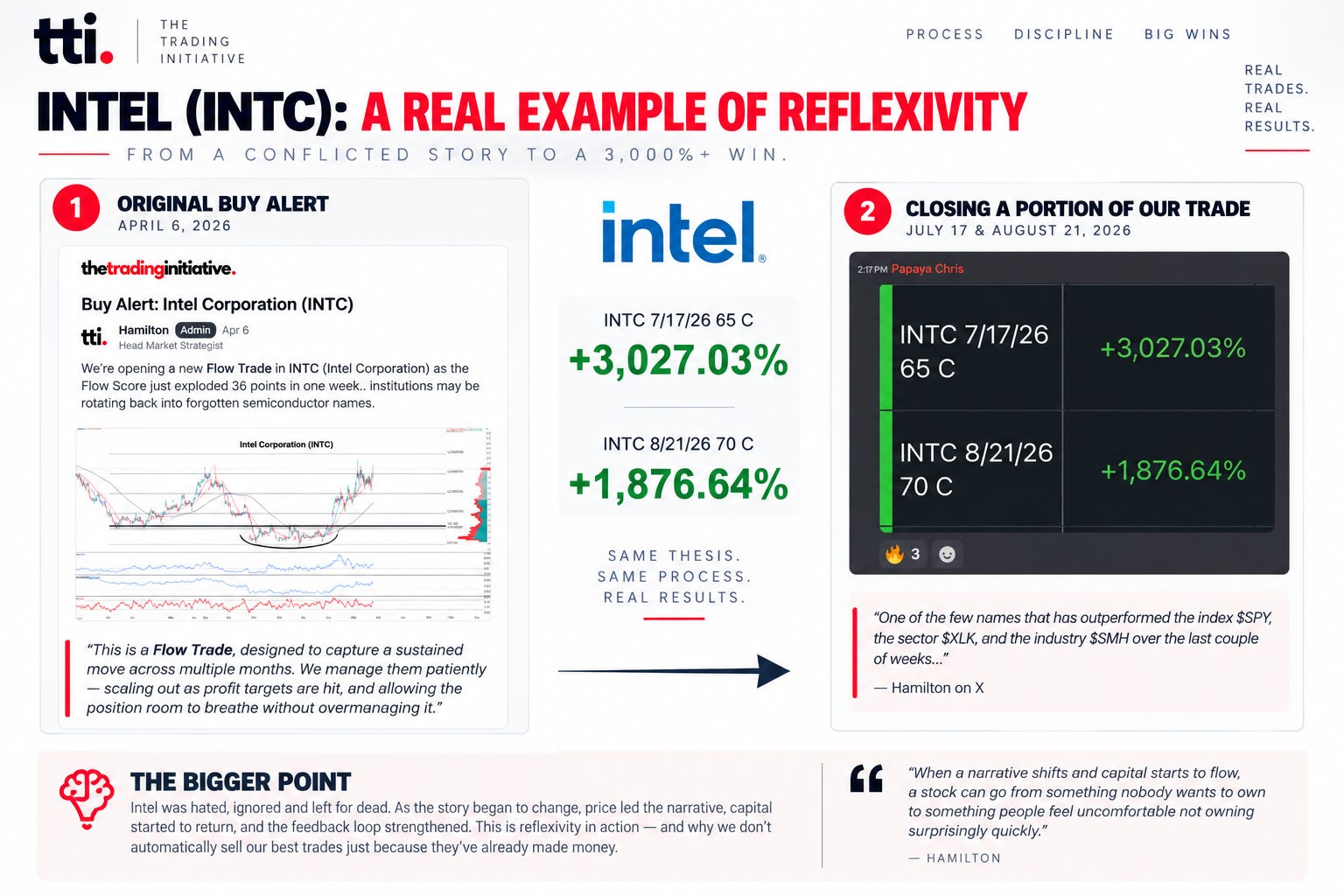
Intel is one of the clearest examples for us this year.
We didn’t buy INTC because I woke up one morning thinking about George Soros and decided reflexivity would send the stock higher.
Our process led us there.
The setup improved. The stock started showing strength. The evidence kept getting better. Once the position began working, the question stopped being, “How much money have we made?” and became:
Is the reason for owning this getting stronger or weaker?
That is a much better way to think about a winner.
When consensus begins changing around a company that investors had largely written off, the shift can become powerful. Better price action gets people to notice. The narrative starts changing. More capital begins looking at the stock. Analysts reconsider old assumptions. Investors who had ignored it suddenly become potential buyers.
Something can go from a stock nobody wants to own to one investors become uncomfortable not owning surprisingly quickly.
That does not guarantee the move continues, but it tells me a potentially powerful feedback loop is underway.
And when we get one of those, I want to give it room.
This is what I mean when I talk about finding grand slams.
Not every trade becomes one. Most won’t.
But when the market finally gives you something special, you have to be willing to let special happen.
Reflexivity works in both directions
There is an important caveat here.
Reflexivity does not mean that things going up continue going up forever.
The same mechanism works in reverse.
Price weakens. Investors lose confidence. Capital leaves. Expectations fall. Analysts become more cautious. The narrative deteriorates, which can create even more selling.
Weakness can reinforce weakness just as easily as strength can reinforce strength.
That is why risk management still matters.
We are never married to the story. We are watching the evidence and participating while the feedback loop remains intact.
When the evidence changes, we change with it.
That’s the difference between conviction and stubbornness.
I think we’re watching it happen again
Bitcoin and crypto are where this gets particularly interesting right now.
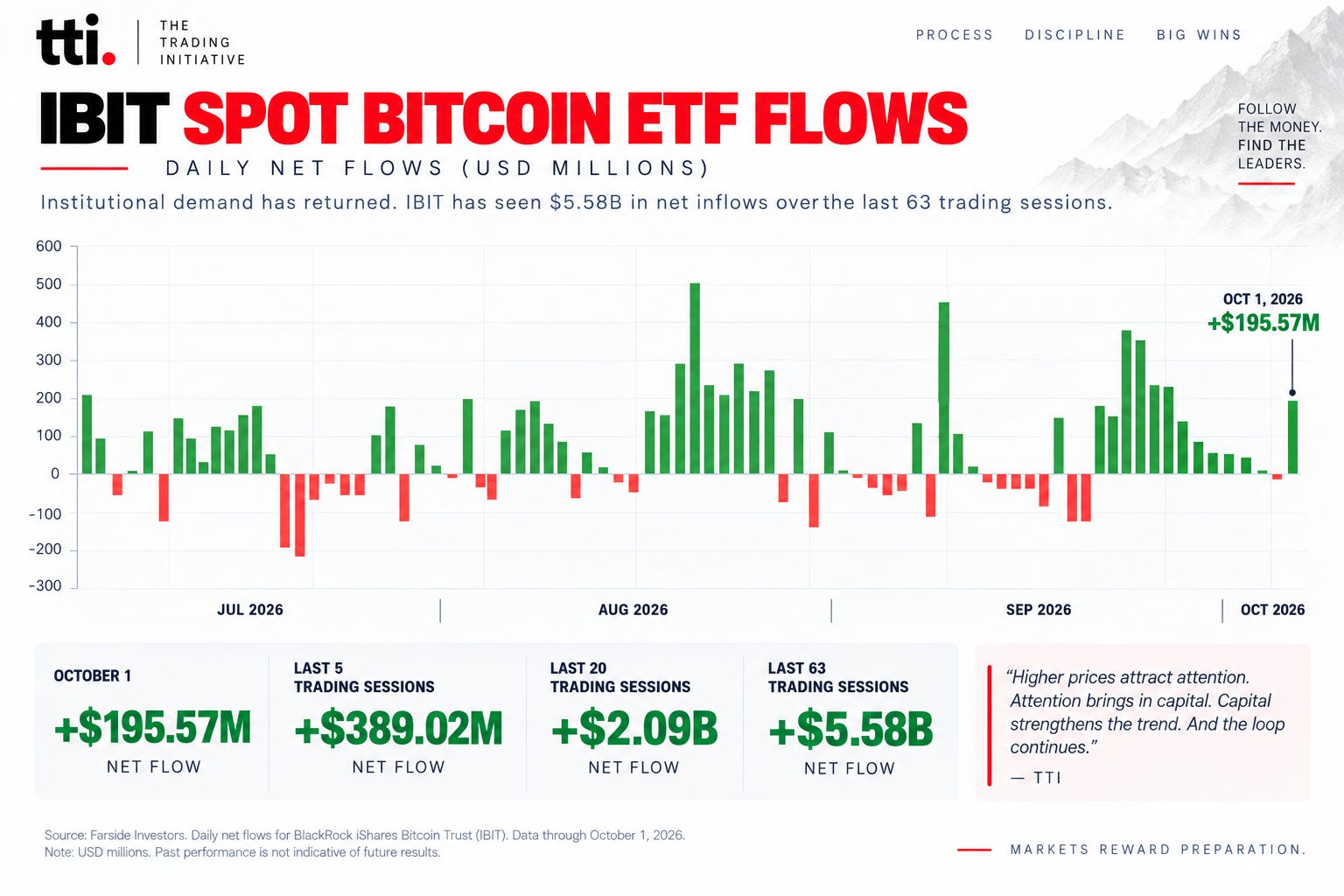
Over the last several months, multiple parts of the story have started reinforcing one another.
Price improved, which improved sentiment. Bette5.58BN r sentiment brought more attention. Institutional ETF demand returned. Those flows brought additional capital into the asset, strengthening the price structure and attracting even more attention.
You can almost draw the loop:
Price → attention → flows → price.
We are already participating in it.
Our crypto positions are working, some of them meaningfully, and my instinct is not to look at those gains and decide that making money is somehow a reason to leave.
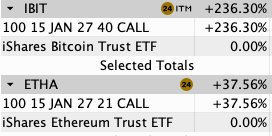
My question is the same one it always is:
Has the loop broken?
Right now, I don’t believe it has.
That doesn’t mean Bitcoin can’t pull back. It doesn’t mean ETF flows can’t weaken or leadership can’t deteriorate. If the evidence changes, we’ll manage that.
But I’m also not interested in selling a powerful trend simply because it has already rewarded us.
That is exactly the kind of mistake reflexivity taught me to avoid.
You don’t have to predict the future
One of the biggest misconceptions about trading is that the goal is prediction.
Call the top. Call the bottom. Figure out what the Federal Reserve will do. Know where Bitcoin will trade six months from now.
I don’t think that’s the job.
A much better question is:
What is already happening.. and is that process getting stronger or weaker?
That is one of the ways reflexivity influences how we operate inside TTI.
We look for leadership. We study where capital is flowing. We measure trend, relative strength and momentum. We wait for an entry we can define. And once we get one right, we try very hard not to interrupt a powerful trend simply because it has already made us money.
I can’t tell you exactly where every great trade will end.
Nobody can.
But I can recognize when a feedback loop worth participating in has already begun.
And sometimes the biggest money isn’t made by predicting what comes next.
It’s made by recognizing what has already started.. and staying with it while the loop keeps getting stronger.
Follow the money,
Hamilton
Founder, The Trading Initiative
P.S. Inside The Trading Initiative, this isn’t philosophy for philosophy’s sake. It influences how we identify leadership, build positions and manage real trades once they start working. Members see the research, the Trade Desk, our positions and the decisions we’re making as they happen. If you want to work through these moves with us instead of reading about them afterward, join TTI.