


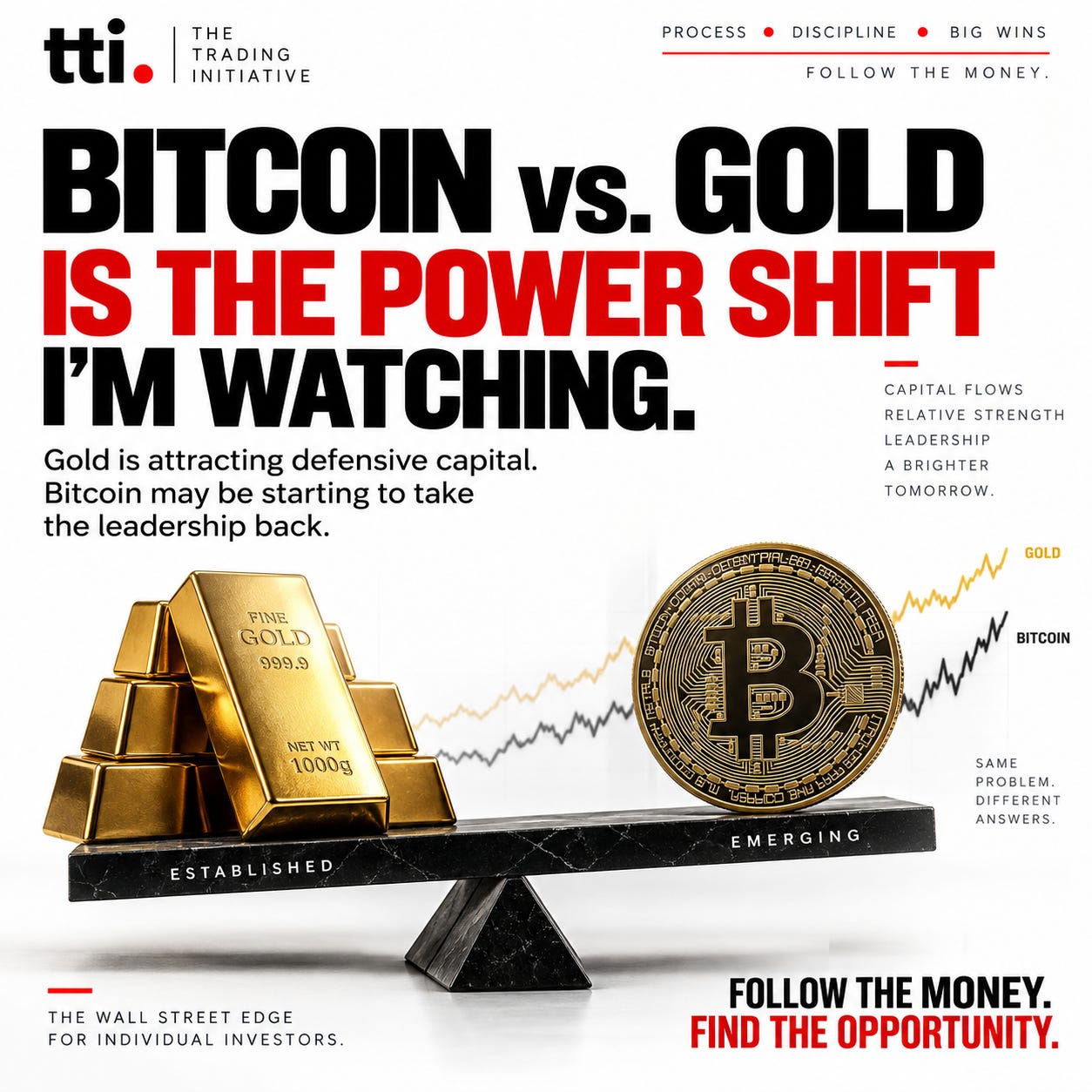
Gold demand remains powerful
Bitcoin is improving against gold
The capital footprint may be shifting
There’s an interesting relationship developing between gold and Bitcoin that I think deserves more attention.
Most investors look at the two assets separately.
They watch Bitcoin in dollars. They watch gold in dollars. Then they argue about which one is the better investment or whether Bitcoin will eventually replace gold.
I think that misses the more useful question.
Gold and Bitcoin are different assets, but they can both attract capital from investors looking for alternatives to a monetary system increasingly dependent on debt, liquidity and expanding credit.
They just don’t respond to that environment the same way.
Gold is the established monetary asset. Bitcoin is the younger, more volatile one.
And when we measure Bitcoin against gold instead of against the dollar, we get something much more useful:
A way to watch the capital footprint between two competing expressions of the same larger monetary theme.
Where is money being rewarded?
Which asset is showing leadership?
And is a power shift beginning underneath the surface?
That’s what I’m watching now.
Gold Is Leaving a Very Clear Capital Footprint
Gold has been doing exactly what you’d expect a trusted monetary asset to do in an uncertain environment.
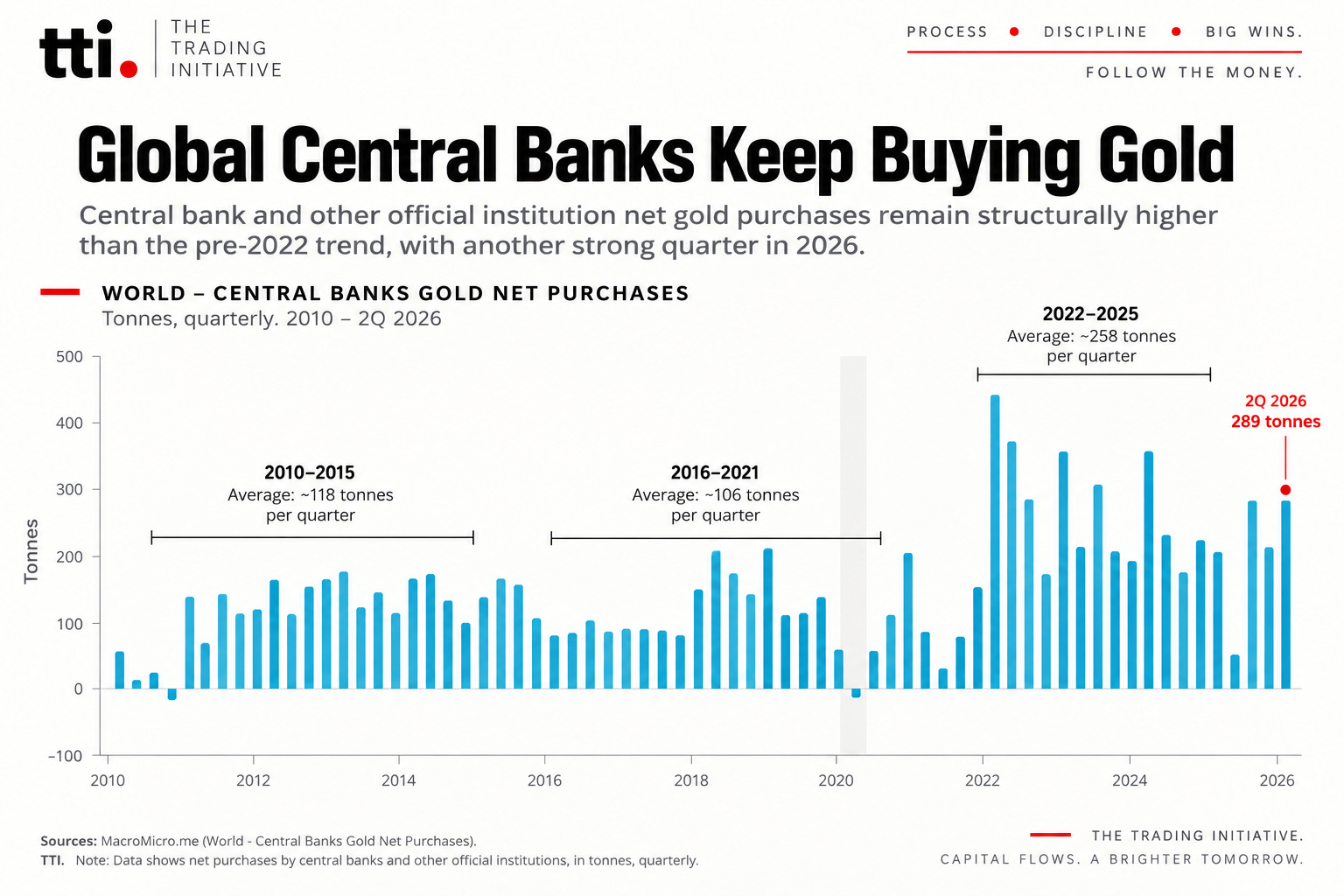
Central banks bought approximately 863 tonnes of gold in 2025, after three consecutive years of purchases above 1,000 tonnes. Official-sector buying then accelerated again to roughly 289 tonnes during the second quarter of 2026.
Those aren’t traders trying to scalp a breakout.
They’re institutions managing national reserves and diversifying monetary exposure.
That doesn’t mean the dollar is about to collapse, and I don’t need that prediction for the opportunity to matter.
What it tells me is much simpler:
Powerful pools of capital continue to want monetary protection.
That leaves a footprint.
Flows. Price. Relative strength. Persistent demand.
This is one of the core ideas behind how we think at TTI.
The biggest institutions in the world have advantages individual investors will never have. Private research. Enormous balance sheets. Teams of analysts. Access to information and capital most people simply don’t have.
But they cannot move billions—or trillions—without leaving evidence behind.
Their money leaves tracks.
Our job is to learn how to see them.
Gold’s capital footprint is obvious.
The more interesting question is whether Bitcoin is beginning to create one of its own.
Bitcoin May Be Taking the Leadership Back
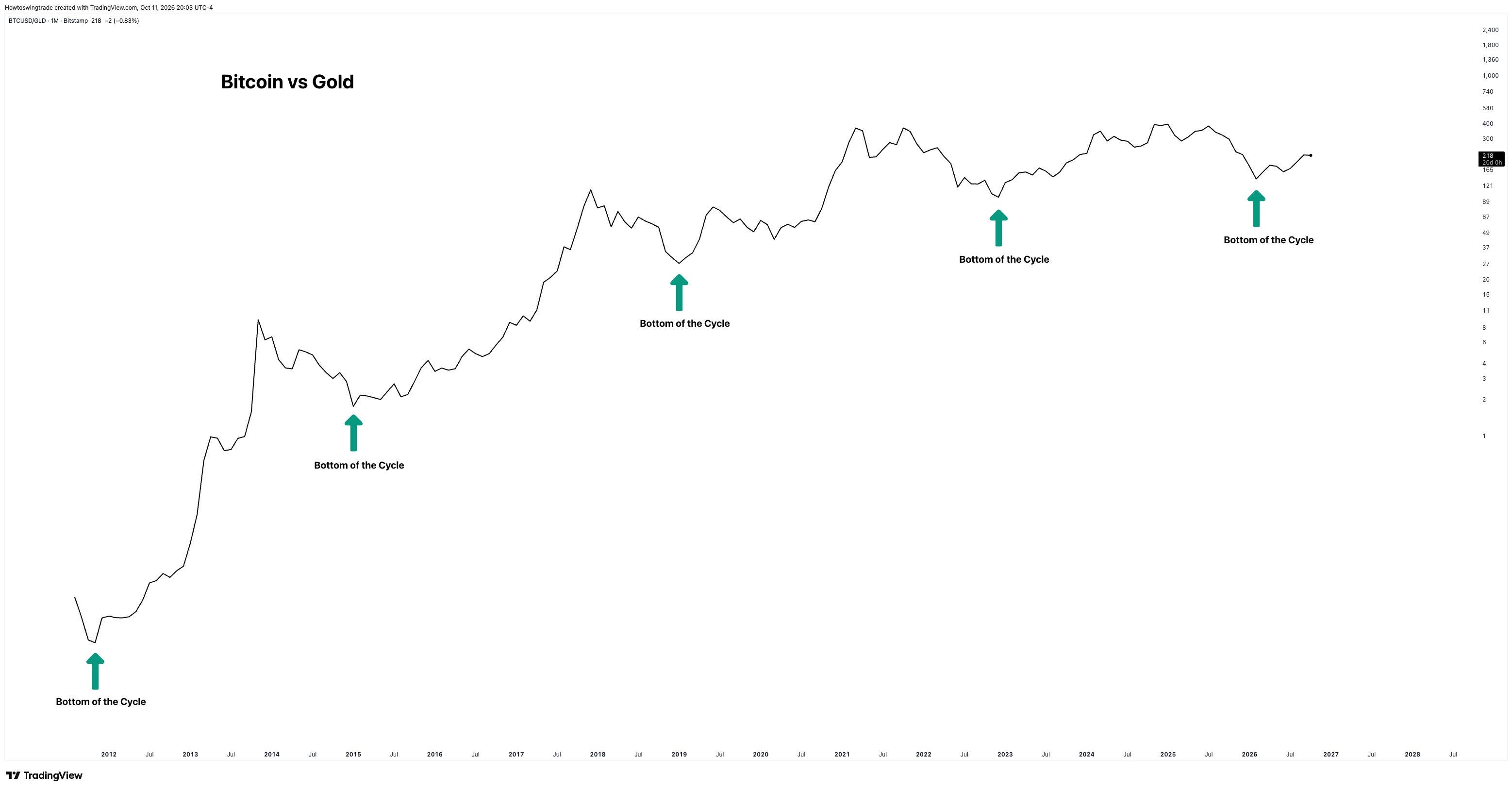
This is the chart I really care about.
Get Hamilton’s market notes and TTI research in your inbox.
Instead of asking how many dollars one Bitcoin is worth, we’re measuring Bitcoin relative to gold.
When the line rises, Bitcoin is outperforming gold.
When it falls, gold is winning.
Think of it as a power-shift chart.
We’re not asking whether gold is good or Bitcoin is bad.
We’re asking:
Which asset is attracting the stronger bid?
Look at the history.
Bitcoin has gone through several enormous periods of relative outperformance, followed by deep resets where gold regained leadership.
Those resets were uncomfortable.
But historically, some of Bitcoin’s most important advances began after its relative performance against gold had already been crushed and then started turning higher.
Now look at the right side of the chart.
Bitcoin has gone through another major relative decline.
And it is beginning to recover.
I am not declaring a cycle bottom because the chart looks similar to something that happened before.
Historical analogs are useful context.
They are not guarantees.
What I care about is whether this recovery turns into a sustained relative uptrend.
Because that would tell us something far more useful than another Bitcoin price target.
It would tell us the capital footprint is changing.
Investors would be moving from the established, lower-volatility monetary asset toward the younger, higher-beta one.
That is a power shift.
And we already have another piece of evidence worth watching.
In Institutions Are Buying Bitcoin Again, we looked at institutional demand returning through the Bitcoin ETF complex. Our IBIT data showed billions of dollars flowing back into the product while Bitcoin’s price structure was improving.
That is exactly the kind of evidence I want.
Price strengthening. Flows strengthening. Relative strength improving.
Different pieces of the market telling the same story.
If ETF demand continues improving and Bitcoin begins sustainably outperforming gold, the signal becomes much harder to dismiss.
Capital is returning.
Leadership may be changing.
And that is when I start paying very close attention.
Follow the Power Shift
This does not need to become another gold-versus-Bitcoin argument.
Gold does not have to lose for Bitcoin to win.
Imagine an environment where government borrowing remains elevated, monetary uncertainty persists and liquidity continues expanding over time.
Both assets can attract capital.
But they can attract different kinds of capital at different points in the cycle.
Gold can lead when investors want protection.
Bitcoin can lead when investors want that same monetary alternative with more upside and more risk.
That makes Bitcoin/gold useful to me as more than a relative-performance chart.
It gives us an Inside Track on risk appetite inside the monetary trade itself.
Gold tells us demand for protection is strong.
Bitcoin outperforming gold tells us investors may be becoming more aggressive about how they express that demand.
That distinction matters.
And it is exactly why I would rather watch the capital footprint than argue about narratives.
We don’t need to predict whether Bitcoin replaces gold.
We don’t need to predict the end of the dollar.
We don’t need another philosophical debate about what constitutes “real money.”
We need to watch where the power is shifting.
Right now, I’m watching three things.
I want gold demand to remain strong because that confirms the larger monetary theme.
I want Bitcoin ETF flows to continue showing institutional sponsorship.
And most importantly, I want Bitcoin to keep improving relative to gold.
If those pieces begin reinforcing one another, Bitcoin may be setting up for another major period of leadership.
If Bitcoin rolls back over against gold, then the market is telling us the power shift isn’t ready yet.
That’s fine too.
We don’t have to force the conclusion.
We just follow the evidence.
Wall Street’s edge has never been that they can perfectly predict the future.
It’s that they have the resources to see where capital is moving and position around those shifts.
We can’t replicate all of those advantages.
But we can watch the footprint their money leaves behind.
And when that footprint begins changing?
We pay attention.
Because the biggest opportunities often emerge before the new leadership becomes obvious to everyone else.
Follow the money. Find the power shift. Get there before the crowd.
Hamilton
Founder, The Trading Initiative
P.S. — Inside TTI, this is what we mean by getting an Inside Track. We follow capital flows, relative strength and leadership to identify where the market’s biggest players are creating opportunity—then we look for a trade where the structure and risk make sense. If Bitcoin’s relative leadership continues improving, we’ll be working through it together inside the Trade Desk, research and live sessions.