


Agentic trading is coming fast
Automation amplifies your process—for better or worse
The real edge still comes before the agent
Something happened inside TTI this week that I think is a preview of where trading is going.
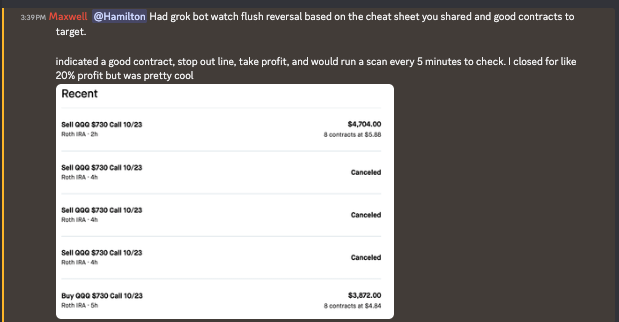
One of our members took an intraday strategy we teach, gave the rules to Grok, and had the agent monitor the market for the setup.
It identified the contract.
It defined the stop.
It defined the take-profit level.
It checked the market every five minutes.
And when the setup appeared, he traded it.
He closed the position for nearly $1,000.
The obvious takeaway is:
Wow. AI can trade now.
I think that misses the bigger point.
The bot wasn’t the edge.
The system was.
Automation Makes Everything Faster
I think agentic trading is going to become a normal part of markets.
Instead of sitting in front of six screens waiting for a setup, traders will increasingly have agents watching hundreds of stocks, options chains, market internals and conditions simultaneously.
They’ll monitor. They’ll calculate. They’ll alert.
Eventually, many will execute.
That sounds like an enormous advantage.
And it can be.
But there’s another side to it.
AI can automate a bad trading process just as easily as a good one.
Give an agent bad rules and it doesn’t suddenly make them intelligent.
It simply follows the bad rules faster.
Tell it to chase every breakout and it can chase hundreds of them.
Tell it to average down every time a stock falls 5% and it can systematically destroy an account.
Tell it to trade without knowing where it’s wrong and you haven’t eliminated emotion.
You’ve eliminated the human being who might eventually realize something is wrong.
The future may create incredibly efficient traders.
It is also going to create incredibly efficient ways to lose money.
That’s why I think the value of having an actual process is about to increase—not decrease.
Want more trading frameworks like this in your inbox?
The Rules Come Before the Robot
The strategy our member automated is what we call the Flush Reversal.
The setup itself is simple.
A major index gets washed out intraday.
But instead of buying because price “looks oversold,” we look underneath the market.
Here it is. Steal it. I don’t care. We have dozens more.
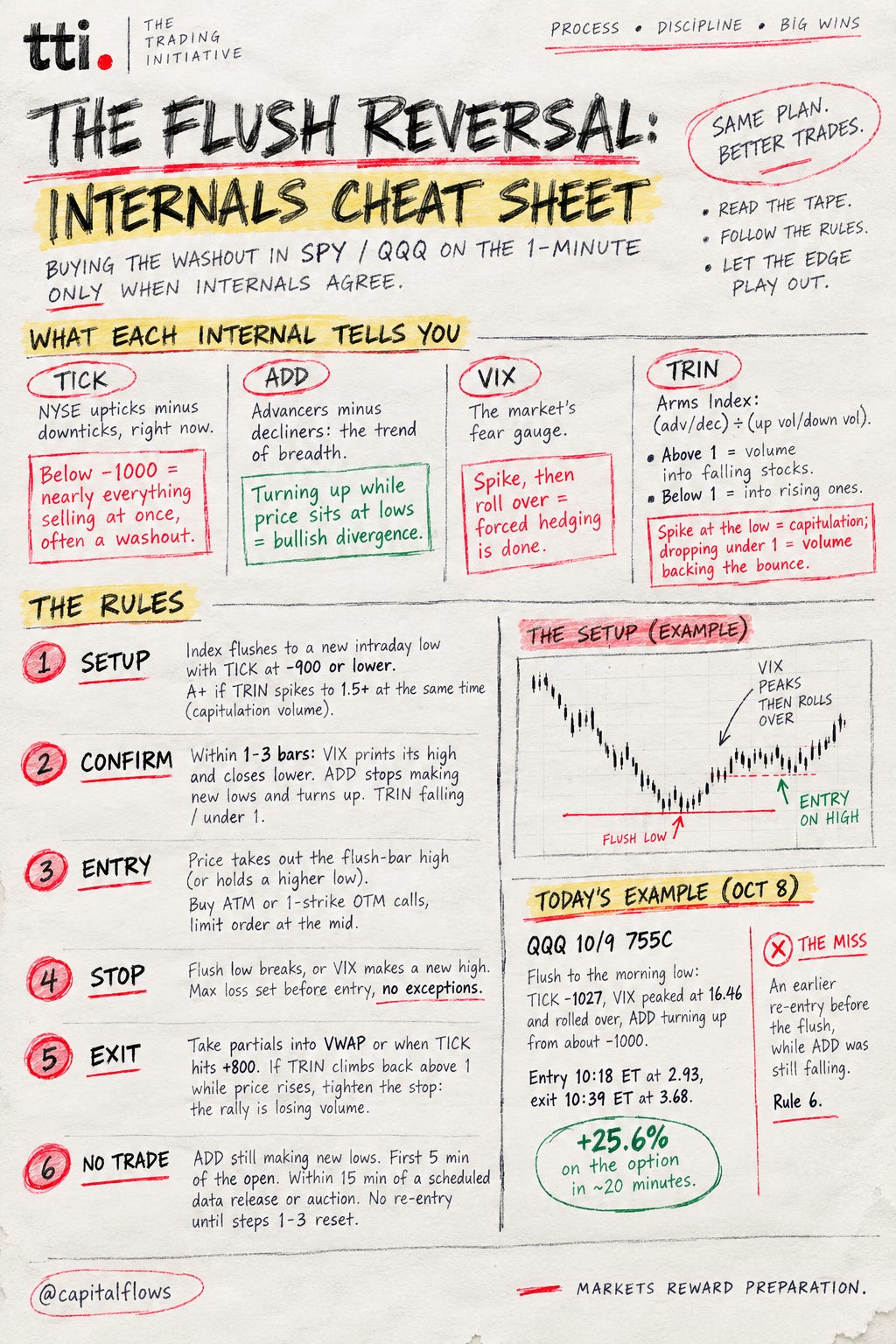
We watch things like:
TICK — Is nearly everything being sold at once?
ADD — Is market breadth still deteriorating, or is it beginning to turn?
VIX — Did fear spike and then begin rolling over?
TRIN — Is volume showing capitulation and then starting to support the bounce?
The trade only happens when those pieces begin agreeing.
That tear sheet is basically an algorithm written in plain English.
And this is already going beyond one experiment.
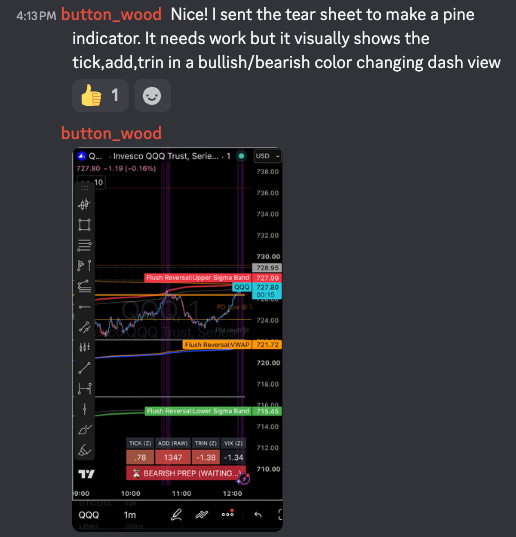
Another TTI member took the same tear sheet and started turning it into a Pine indicator that changes with the market internals in real time.
It still needs work.
But that’s exactly the point.
A repeatable trading process can be taught to software.
The hard part was never the code.
The hard part was having rules worth coding.
There is a setup. There are confirmation rules. There is an entry. There is an invalidation. There are exit rules.
There are conditions where we explicitly do not trade.
That is exactly the kind of structure an agent can work with.
And that’s why I think the member’s experiment is so interesting.
He didn’t ask Grok:
“Find me a good trade.”
He gave it a repeatable process and asked it to watch for the conditions.
Huge difference.
This Goes Way Beyond Intraday Trading
The same idea applies to the way we swing trade.
Our Market Blueprint tells us where we want to be taking risk.
What is the market doing? Where is leadership? Which sectors and industries are attracting capital?
Then our Hit List works from the bottom up.
Which stocks have the best combination of:
Trend. Relative strength. Momentum.
From there, we still need a setup.
Then an entry. Then a place where we’re wrong. Then position size. Then management.
In other words:
Market Blueprint → Where
Hit List → What
Setup → When
Risk → How much
An agent can eventually help us process all of that much faster.
Imagine an agent watching every stock in the market for our Hit List characteristics while simultaneously monitoring sector leadership, capital flows and the Market Blueprint.
Then it tells us:
“These five stocks are in the strongest areas of the market, meet your leadership criteria, and are now approaching setups that fit your rules.”
That is extremely powerful.
But only because the framework existed first.
The agent does not create the edge.
It scales it.
That’s the part of agentic trading I’m excited about.
Not replacing judgment with AI.
Taking a disciplined process that already works in live markets and giving it the ability to watch more, react faster and miss less.
Because the traders who benefit most from AI probably won’t be the ones with the fanciest agents.
They’ll be the ones who know exactly what they want those agents to do.
Bad process + automation = faster losses.
Good process + automation = leverage.
The technology is changing.
The principles aren’t.
Process first. Agent second.
— Hamilton
Founder, The Trading Initiative
P.S. — Agentic trading is going to become a much bigger part of what we do inside TTI. The advantage isn’t asking AI to magically find trades. It’s giving AI the Market Blueprint, Hit List, intraday setups, risk rules and trade-management frameworks we already use—then letting it help us apply them at a scale no human trader can match. If you want to build that edge with us, join TTI here.
Excellent distinction between automating a process and creating an edge. One additional challenge is ensuring the system behaves correctly when conditions deteriorate. Stale data, rejected orders, and connectivity failures can undermine even well-defined strategies. How much emphasis would you place on automated fail-safes before allowing an agent to execute independently?